We hear this term in the news a lot. The economic downturn supported by the de-globalization triggered by the Russia-Ukrainian war as well as the increase in energy costs caused this term to appear in the news on the daily basis. The worst problem is that it is not localised around one country or a region, but rather global.
Put in simple words, inflation is the decline of purchasing power over time. There are many measures of it, however the most common one is consumer price index (CPI). This is a quantitative measure of the increase in average price level of selected goods and services over a specified period. The basket is split into three categories: total, food and energy. The rise in the price level is as a percentage over some time and is typically measured year on year.
For an average person, the rise in inflation means that they can afford less in their everyday life. In poor countries it can even increase the deathrates due to lower disposable incomes of population and inflation’s impact on the cost of necessities such as food and shelter.
It is quite interesting that the governments typically prefer to post the inflation metrics excluding food and energy prices. Based on the current state of world economy this would be extremely misleading as food and electricity had the most significant increase.
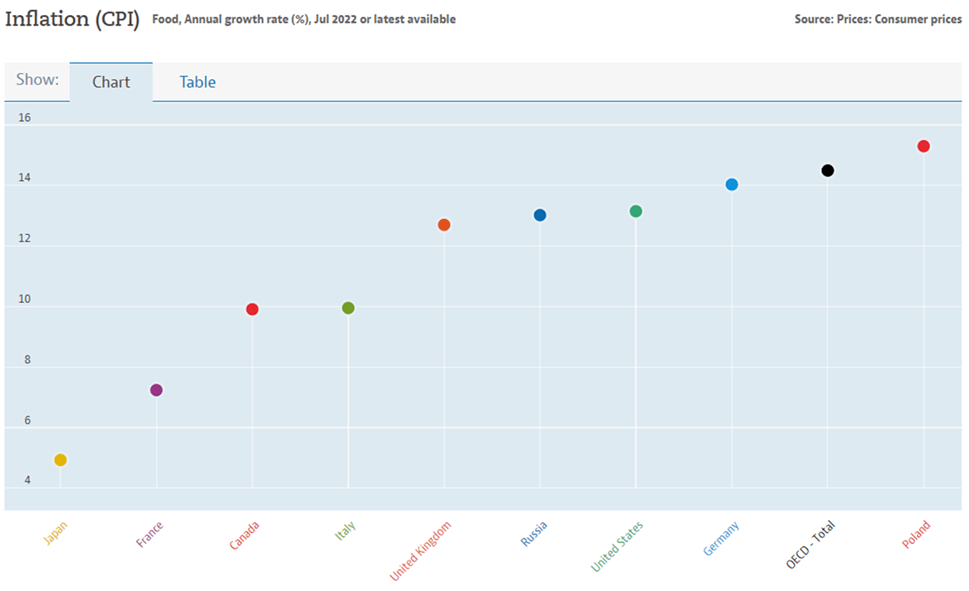
I have sourced data from OECD website for the latest year on year inflation across a number of world markets, which includes Japan, France, Canada, Italy, UK, Russia, US, Germany, Portugal, and summary for OECD. I have added Russia into the equation to display how harshly the impact of sanction has hurt the purchasing ability of the countries imposing the sanctions. Hopefully this negative impact will be short-lived, but it can also be far from being ‘transitory’.
Food CPI for the last year to July 2022
Food and Energy CPI for the last year to July 2022
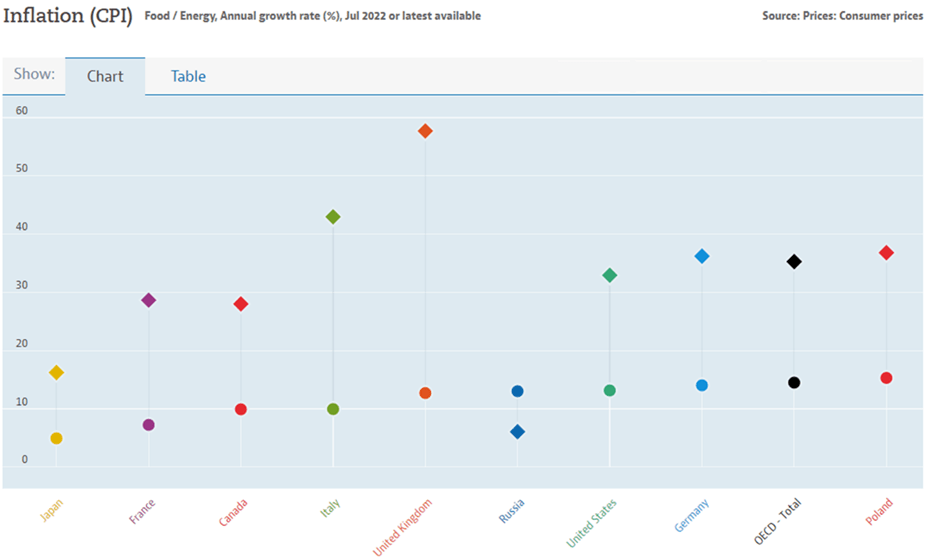
The energy inflation displays that the inflation can hit even harder over the next 12 months as part of the energy costs will result in higher productions costs for the businesses. While the companies can absorb part of it, majority of the price increase is likely to result in the price hikes of the end products. We can see that UK and Italy are leading in the energy price increases with UK energy inflation hitting almost 60% and Italy at roughly 45%. CPI across all of these countries is in double digits with Russia only one having a single-digit change.
Please note, none of the information on this blog represents the opinion of my employer and all information does not represent a financial advice.
 Learn Finance 101